Medicare Price “Negotiations” Will Jeopardize Patient Access to New Medicines, Result in Worse Health Outcomes

September 11, 2023

September 11, 2023

The Centers for Medicare & Medicaid Services (CMS) recently announced the first 10 drugs selected under its Medicare drug price “negotiation” plan, authorized by the Inflation Reduction Act (IRA) signed in to law last year. Over the next 4 years, Medicare will set prices for up to 60 drugs covered under Medicare Part D and Part B. This shortsighted move won’t control costs and threatens to limit patient access to new medicines, ultimately resulting in worse health outcomes for U.S. patients, warns ASBM.

IRA Changes Break a Successful Program
Michael Reilly, ASBM Executive Director and former Associate Deputy Secretary in the U.S. Department of Health and Human Services, worked on the development and implementation of the Part D prescription drug benefit during his six years in the Secretary’s Office. While proponents of government price-setting in Medicare claim this will create savings and lower costs, Reilly disagrees:

“Part D was designed following two decades of experience seeing government price-setting fail to control Medicare costs for services and healthcare provider rates. To avoid this happening with the new prescription drug benefit, we created a new model. Contrary to what many believe, under Part D, drug price negotiations do occur- they are conducted by pharmacy benefit managers (PBMs), and the law specifically forbid government interference in price-setting or formulary selection. As we intended, this approach has been incredibly successful in controlling costs:  the Congressional Budget Office projected drug spending between 2004-2013 to be $770 billion; actual expenses were 45% lower- at $421 billion. It has a 90% approval rating among beneficiaries[1], premiums have held steady around $32/month since 2006, and it holds the distinction of being the only major federal program to ever come in under budget.”

A Better Reform: Ensuring Savings Are Passed Onto Patients
While price-setting proponents say beneficiaries will start to see lower drug prices beginning in 2026, there’s no evidence that this is true, and there are better ways to lower out-of-pocket costs- and much faster, Reilly explains. “Part D has been hugely successful in lowering costs- but these savings are not always being passed on to the patient by the PBMs. Thankfully, there is a broad bipartisan effort underway in Congress to rectify this and provide immediate relief for patients- this year, not in 2026.” No fewer than eight bills have been introduced or advanced out of committee this session, with bipartisan support, to address PBM rebate and pricing policies that result in higher drug prices for patients.

The Consequences of European-style Drug Price-Setting Policies

Not only will it fail to control costs, imposing European-style price controls on Medicare Part D will spell disaster for American patients in the coming years. Reilly remarks, “The U.S. leads the world in drug innovation and patient access precisely because we’ve rejected the kind of price controls that stifle R&D and delay drug availability in Europe and Asia.” For example:

  • In the 1970s, European companies developed most new drugs; however, since the implementation of price controls in Europe, U.S. companies now produce 60% of new drugs, while European countries often have percentages in the single digits.[1]
  • 90% of new cancer drugs are available in the U.S. within the first year, whereas fewer than half are available to cancer patients in Germany, the UK, France, and Canada[2]
  • European cancer death rates are 1.7 times higher than in the U.S.[3]

Reilly describes what European-style health outcomes might look like in the U.S:  “Imagine if the U.S. had European cancer death rates. That would translate to an extra 420,000 cancer deaths annually. Europe’s drug price-setting is simply not a policy worth emulating, and American patients should be aware of its public health consequences.”

ASBM Leading Education Efforts
ASBM has submitted comments to CMS critical of the policy and is conducting an educational campaign about the policy’s harmful effects. On July 26th, ASBM hosted a webinar with the Generics and Biosimilars Initiative (GaBI) to examine the price-setting policy’s impact on drug development and reduced patient access to new medicines. The event featured three former government officials who were instrumental in the development of Medicare Part D’s prescription drug benefit; as well as experts from the fields of cancer drug research and patient advocacy, each of whom voiced their strong concerns with the policy individually and in a panel discussion.

ASBM also maintains an educational microsite for the patient community at IRAPatientInfo.org


The Alliance for Safe Biologic Medicines (ASBM) is a diverse group of stakeholders that includes physicians, pharmacists, patient advocates, researchers, and biopharmaceutical manufacturers. Since 2010, ASBM has worked closely with regulators worldwide as they develop and implement health policies, to ensure that these reflect the best interests of patients.

[1]Europe negotiates a poor vaccine rollout”; Forbes, April 2021

[2] IQVIA Analytics, FDA, EMA, PMDA, TGA, & Health Canada data, April 2021.

[3]Democrat plan on drug costs will stifle innovation”, San Antonio Express-News, May 12, 2021


[1] https://www.usatoday.com/story/onpolitics/2012/10/03/poll-medicare-prescription-drug-program-popular/1609995/

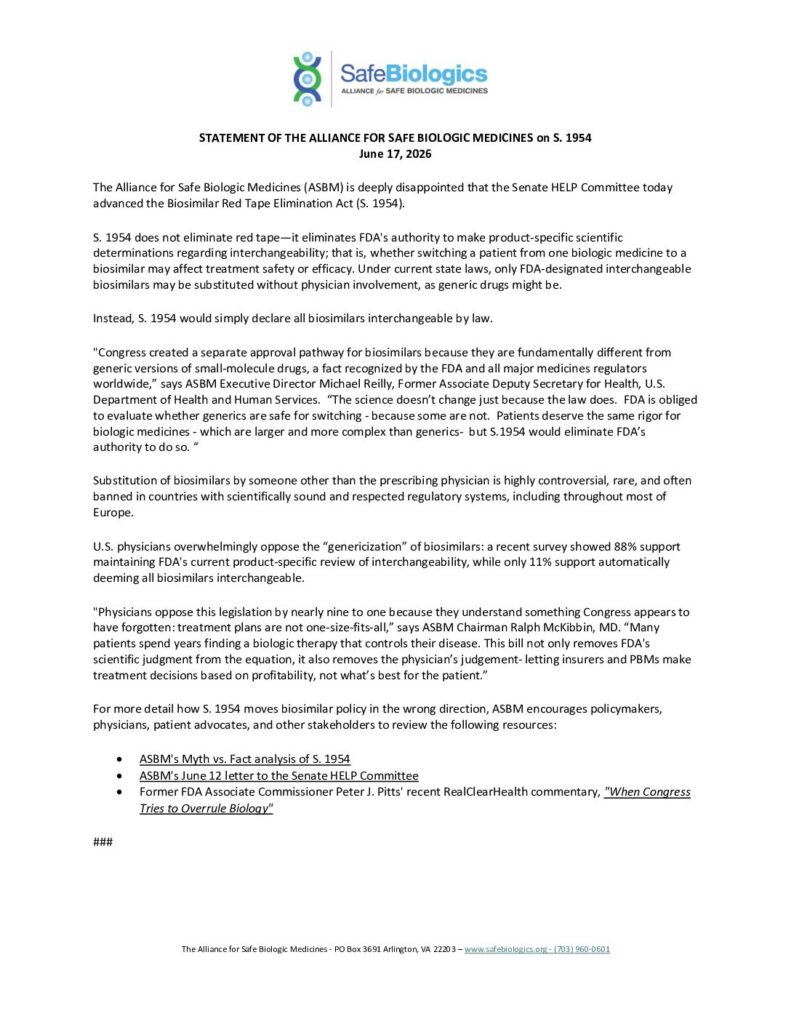
ASBM Urges CO PDAB to Reject Upper Payment Limits Without Patient Protections

May 19, 2026

On May 15, ASBM submitted comments to the Colorado Prescription Drug Affordability Board urging it not to impose an upper payment limit (UPL) on Cosentyx unless the Board can demonstrate that the policy will directly reduce patient out-of-pocket costs without disrupting access to treatment.

ASBM emphasized that a UPL would reduce the amount paid by insurers or pharmacy benefit managers (PBMs), but would not require those savings to be passed along to patients at the pharmacy counter. Many commercially insured patients already pay little or nothing for Cosentyx through existing copay-assistance programs, while patients who continue to face affordability challenges often do so because of deductibles, coinsurance, restrictive formularies, prior authorization, step therapy, copay accumulator programs, or specialty-pharmacy restrictions—none of which would be addressed by a UPL.

“A UPL that reduces reimbursement but leaves those mechanisms untouched would reduce spending and increase profitability for insurers or PBMs, while doing little or nothing for the patient,” the letter stated.

ASBM also warned that payment caps could prompt insurers and PBMs to impose new formulary restrictions or administrative hurdles, potentially disrupting stable patients who have arrived at an effective biologic therapy only after trying and failing other treatments.

The letter urged the Board to require enforceable patient pass-through protections, monitor formulary and utilization-management changes, protect patients from forced switching, and establish a process to suspend or revise any UPL if patient access worsens or savings fail to reach patients directly.

“The patient—not the PBM, not the insurer or another intermediary—should be the primary beneficiary of any cost-control measure,” the comments concluded.

Read the comment letter below:


ASBM Submits Comments to FDA on Biosimilar Draft Guidance

May 15, 2026


On May 11th, ASBM submitted comments on the FDA’s recently released draft guidance and Q&As aimed at “streamlining” biosimilar development by permitting the use of data from non-U.S.-licensed comparator products and foreign clinical studies in the U.S. biosimilar approval process. While efficiency is important, ASBM is concerned that these changes may lower evidentiary standards in ways that risk undermining physician and patient confidence in biosimilars. 

Biosimilars are safe and effective—but they are not generics. Reducing the role of clinical and pharmacokinetic data too aggressively, while promoting a simplified regulatory approach, risks blurring the scientific distinctions that underpin the biosimilar pathway. ASBM believes that the FDA maintaining a science-based, case-by-case approach is essential to preserving trust in biosimilars and ensuring patient safety.
From ASBM’s comments:

The FDA’s proposed approach to biosimilar approval stands in stark contrast to the rigor traditionally expected of innovator medicines, which must independently demonstrate safety and effectiveness through substantial evidence, generally grounded in well-controlled clinical investigations. For example, in Q.I.8.a, lines 164–168, the draft permits “analytical differences identified in product quality attributes between the non-U.S.-licensed comparator product used in the clinical study and the U.S.-licensed reference product included in the applicant’s comparative analytical assessment,” so long as the sponsor provides “an adequate scientific rationale” for those differences. This language could be read to suggest that if a biosimilar manufacturer offers a plausible explanation for detected quality differences, that rationale may be accepted without requirement to demonstrate its basis in fact. This raises an alarming possibility, as physicians and patients expect confidence in the quality of FDA-approved medicines, not merely adequate or plausible explanations – particularly when those medicines are complex biologics used by patients with serious and chronic conditions.

Maintaining physician and patient confidence in third-party biosimilar substitutions is critical, as biologic treatment is highly individualized and often involves patients with chronic, complex conditions. In ASBM’s national physician surveys[1], 89% of prescribers expressed high confidence in the safety and effectiveness of biosimilars[2], and 88% of U.S. physicians supported maintaining the FDA’s case-by-case approach to interchangeability, but only 11% favored treating all biosimilars as interchangeable by default.[3] This suggests that the FDA’s rigorous, evidence-based framework has been effective at building confidence in biosimilars among physicians, but that confidence could be undermined if biosimilars are treated more like generics without proper, individual evaluation.


[1] http://www.safebiologics.org/surveys

[2] https://safebiologics.org/wp-content/uploads/2023/08/ASBM-2021-US-Biologics-Prescribers-Survey-Specialty-Data.pdf

[3] https://safebiologics.org/wp-content/uploads/2024/09/ASBM-US-Physician-Survey-IC-Biosims.pdf

Read ASBM’s full comments below:

Read the FDA announcement about the new Guidance and Q&As.


Take Action: Support the MINI Act to Protect Patient Access to Genetic Therapies

May 9, 2026

Congress is considering the Maintaining Investments in New Innovation Act (MINI Act) [HR 1672], legislation to protect patient access to genetically targeted therapies (GTTs)—innovative treatments designed to address the underlying genetic causes of serious diseases.

Under current law, some of these therapies may face Medicare price controls earlier than similarly complex treatments, simply due to how they are classified. That shortened timeframe to recover research and development costs risks discouraging investment and limiting future treatment options.

Patients should not lose access to life-changing therapies because of a technical classification issue. The MINI Act would help correct this imbalance and preserve incentives for innovation.

Click Here to Tell Your Members of Congress to Support the MINI Act


Tell Congress: Support the SAFE Drugs Act

April 16, 2026

ASBM is urging Congress to pass the SAFE Drugs Act of 2026, legislation designed to strengthen oversight of unsafe, unapproved, and mass-marketed copycat medicines.

Pharmacy compounding plays an important and legitimate role in patient care when FDA-approved therapies are unavailable or when a patient has a specific clinical need that cannot be met by an approved product. However, in recent years, some large-scale compounding operations have expanded into interstate distribution of products that closely replicate commercially available, FDA-approved drugs—without undergoing the rigorous FDA review, inspection, and approval standards that protect public health.
Patients deserve to know that the medicines they receive are what they claim to be—and that they have been made under appropriate safeguards.

CLICK HERE to tell your Senators and Representative to support the SAFE Drugs Act.

Read ASBM’s letter supporting the SAFE Drugs Act of 2026 here.

CO Bills Address Compounding Risks and Patient Safety

April 12, 2026

ASBM recently engaged on two bills in Colorado addressing oversight of drug compounding and patient safety. The organization supports SB 26-130, which adds targeted safeguards for med spas and other settings handling prescription drugs, helping ensure that these products are stored, handled, and administered safely.

At the same time, ASBM opposes HB 26-1262, which would limit Colorado’s ability to go beyond federal standards to address emerging risks in drug compounding. At a time when concerns are growing about the mass production and marketing of copycat medicines, states should retain the flexibility to strengthen oversight and respond to new safety challenges.

Together, these bills highlight an important policy question: whether states will take steps to enhance patient protections or risk weakening them. ASBM continues to support a balanced approach that preserves access to legitimate, patient-specific compounding while ensuring appropriate safeguards are in place to protect patients.

A recent Washington Post opinion piece details the devastating consequences that can occur when compounded medicines are used without adequate safeguards. The author, who suffered acute liver failure after taking a compounded GLP-1 product, describes a troubling reality: many patients assume compounded drugs are held to the same standards as FDA-approved medicines, when in fact they are not. 

ASBM Advisory Board Members Philip Schneider and Dean Jordan’s recently authored a Washington Times article about the importance of compounding oversight. Read it here.

Learn more about pharmacy compounding at ASBM’s microsite SafeRxCompounding.org


ASBM Opposes CA Bill to Permit Pharmacy Substitution of Non-Interchangeable Biosimilars

March 26, 2026

ASBM recently submitted a letter opposing California Senate Bill 1094, which would permit generic-style pharmacy-level substitution of non-interchangeable biosimilars.

While biosimilars are safe and effective, they are not generics—and substitution decisions for biologics should remain grounded in evidence, physician judgment, and patient-specific considerations. 

California’s current framework appropriately allows substitution only for biosimilars that meet the FDA’s higher standard for interchangeable biosimilars. Interchangeable status is granted by the FDA only after additional data are provided by the biosimilar manufacturer to demonstrate that switching will not reduce either safety or treatment efficacy.

“Nationwide, support for permitting biosimilar substitution from state medical societies and patient advocacy organizations was conditional on it being limited to interchangeable biosimilars,” says ASBM Executive Director Michael Reilly. “SB 1094 would remove that safeguard, potentially disrupting treatment stability for California patients and reducing physician and patient confidence in biosimilars.”

A recent survey of 270 physicians found only 11% believe that all biosimilars should be treated as interchangeables; i.e., substitutable by third parties without prescriber involvement, as SB 1094 would permit.

Read ASBM’s opposition letter here.


FDA Chaos Threatens Administration’s Drug Agenda and Risks Patient Safety

March 17, 2026

Washington Examiner (Opinion): 
FDA Chaos Threatens Administration’s Drug Agenda and Risks Patient Safety

March 15, 2026 | Dr. Cristina Beato 

The Trump Administration recently celebrated one year of embracing the movement to Make America Healthy Again. Unfortunately, many of these successes are overshadowed by slapdash decision-making at a key health agency, which significantly undermines the Administration’s goals, threatens treatment access, choice, and safety for American patients, and hinders our longstanding reputation as a world leader in medical innovation.

For over 100 years, the Food and Drug Administration (FDA) has played a vital role for American patients and drug manufacturers, establishing rigorous, science-based standards and clear approval processes for lifesaving treatments.  Prior to this year, the FDA has been considered the “gold standard” among global regulatory bodies. This reputation, however, has been severely diminished during the past year by agency decision-making that has left Americans baffled and concerned.

In 2025, the FDA slashed its sizeable workforce by nearly 4,000, but the arbitrary nature of the dramatic reduction in force was evident in the subsequent rehiring of some of those staff members, prompting widespread alarm. Turnover has not been isolated to rank-and-file staff, as the Center for Drug Evaluation and Research (CDER) churned through four leaders over the course of 2025, including cancer researcher and founder of the FDA’s oncology center Richard Pazdur, who would go on to retire a mere three weeks into his tenure. The instability continued when Vinay Prasad (previously fired in July 2025 and rehired less than two weeks later as Director of the Center for Biologics Evaluation and Research) was announced to be departing yet again. This leadership turmoil is emblematic of the broader chaos engulfing the agency.

Pazdur warned earlier this year that the chaos at the FDA has extended to the agency’s approach to its core regulatory functions, and recent developments have unfortunately proven him correct. The guidance coming out of the FDA is not only shortsighted but also often hypocritical and directly self-contradictory.  The FDA’s management has lost sight of its North Star – its commitment to following the science, which previously made it the most trusted regulator in the world. Course-correction is needed to ensure the core functions of safety, efficacy, and affordability of medications, and to regain Americans’ trust.

Take Moderna’s recent experience navigating contradictory and confusing FDA messaging during the vaccine approval process. In February, the FDA refused to review Moderna’s new mRNA flu vaccine due to issues with the company’s comparator study design, which Moderna claimed contradicted earlier agency guidance. After several weeks of industrywide outcry at the decision, the FDA reversed course, but the damage was already done. The refusal came mere weeks after Moderna announced it was not planning to invest in late-stage studies of several experimental vaccines. This short-sighted, undisciplined management undermines America’s leadership in medical innovation and the proven economic benefits that flow from it.

Other manufacturers have similarly faced abrupt rejections of applications for new treatments over clinical trial issues, including a cell therapy for patients with Dechenne muscular dystrophy, a viral-based treatment for patients with advanced skin cancer, and a cell therapy for patients with white blood cell disorder, the rejection of which was a reversalof the FDA’s position over five years of meetings. These mounting inexplicable decisions are daily affecting American patients by delaying treatments, stifling competition for affordable medications, and undermining America’s leadership in scientific discoveries.

While the FDA has begun requiring even more evidence for certain vaccines and some therapies, it has taken the opposite approach for other drugs, including biosimilars, without providing a scientific justification for significant policy changes.  In the fall, the FDA released guidance stating that it would no longer require switching studies that demonstrate that a biosimilar is safe and effective when compared to its reference product. Additionally, the agency recently announced that manufacturers can file for drug approval with one pivotal trial, backed by confirmatory evidence, rather than the two pivotal trials that the FDA has consistently relied on. Senior leadership at the FDA defended the measure, arguing that overreliance on two trials no longer makes sense, and said they expect a surge in drug development in response.

Cutting regulatory requirements on the one hand and increasing them on the other does not inspire faith in the agency’s decision-making. Drug development can take a decade or longer and cost hundreds of millions of dollars. Constantly shifting regulatory guidance will only make companies less inclined to invest in new and innovative treatments. In the case of Moderna’s flu vaccine, President Trump reportedly prompted the FDA’s change of heart. While it is reassuring that President Trump and some in the Administration understand what is at stake, counting on case-by-case presidential intervention is no substitute for steady, predictable standards. The President needs a leader at the FDA who understands its mission and has the ability and prudence to manage this vital agency without unpredictability and dysfunction.

The impact of this dysfunction ultimately falls on American patients. If the FDA’s seemingly arbitrary and inconsistent decisions appear ungrounded in science, the hard-earned public confidence in the medicines it approves will suffer. Further, if the agency’s unpredictability makes manufacturers less willing to invest in incremental and breakthrough innovations, it could delay or prevent these treatments from reaching patients and may even make manufacturers think twice about any investment in the U.S. at a time when our global adversaries are eager to gain any advantage.

If a healthy America is the goal, then patients and manufacturers deserve a steady hand that builds trust and innovation, not continued chaos and confusion.

Dr. Cristina V. Beato is an Albuquerque physician and former acting assistant secretary for health at the U.S. Department of Health and Human Services.


Erratic FDA Leadership is Creating a Crisis of Confidence

February 22, 2026

by Michael Reilly, ASBM Executive Director

It feels impossible these days to go a single week without news of another shocking policy move from the U.S. Food and Drug Administration that upends decades-old scientific consensus or agency norms regarding clinical safety data and drug approval standards.

Consider the most recent example. Earlier this month, the FDA abruptly refused to even review Moderna’s application for its mRNA-based flu vaccine in a decision that stunned the FDA’s own career scientists, industry observers, and public health experts alike. Notably, that refusal was followed not by a reasoned, science-driven explanation but by an equally abrupt reversal after public outcry. Similarly, the agency recently announced it will drop its long-standing requirement of two clinical trials for most drug approvals; only a single study will now be necessary.

Both the vaccine flip-flop and the reduction in data requirements are framed as reforms designed to speed access to innovative treatments while promoting confidence in approved products. Yet in practice, they do the opposite: The regulatory whiplash – the lack of consistency from day to day regarding what data is sufficient to promote confidence in our medicines, for example- erodes confidence in the FDA’s judgment and competence within the medical community and among the public it serves.

Headlines over the past year have included phrases like “chaos at the FDA” and “very unusual discord.” A Washington Post editorial warned that the damage from the Moderna reversal “won’t be easy to repair,” cautioning that drugmakers can no longer be confident the ground rules won’t shift mid-trial. The Hill quoted scientific leaders saying “something is very wrong at the FDA,” while The Wall Street Journal described the agency’s actions as “arbitrary government at its worst.”

Perhaps the most worrisome, if less well known, example of the FDA’s abrupt changes to approval criteria is its rejection of the longstanding global scientific consensus surrounding biosimilars- complex biologic medicines that closely mimic previously-approved products. While safe and effective, they are not identical to the original products in the way generics are.

For decades, regulators in the U.S., the EU, Canada, Australia, and Japan have reflected this indisputable scientific fact by treating biosimilars and generics as distinct categories, requiring tailored evidence packages proportional to biologics’ complexity prior to approval, and different substitution policies.

In other words, more robust data — not less — is required, particularly if biosimilars are to be deemed “interchangeable,” meaning substitutable not only by physicians familiar with their patients’ needs, but by insurers and pharmacy benefit managers.

Yet the FDA has announced it intends to “genericize” biosimilars, with Commissioner Marty Makary himself conflating the two different classes in public statements. This shift has alarmed physicians and patient groups who warn that permitting insurers to switch patients en masse to biosimilars as if they were generics (i.e.; without the supporting data currently required) risks destabilizing treatment for the millions of patients who depend on biologic therapies. There is near-unanimity on the subject among U.S. physians: only 11% of U.S. physicians support treating biosimilars like generics; 88% support keeping the current FDA approval criteria. Yet this highly controversial policy is at risk of soon becoming federal law, through codifying legislation tucked into the administration’s broader health package. 

By contrast, in Europe (widely acknowledged as the world leader in biosimilar development and commercialization) most national regulators prohibit generic-style “automatic” substitution of biosimilars by anyone other than the physician. European physicians strongly oppose this practice in their countries, and their U.S. counterparts strongly oppose it here.

And just as troubling, these moves have frequently been accompanied by an unusually high number of senior staff resignations and forced departures. For those who have not served in the Executive Branch, it is vital to understand this is not just routine staffing churn. It is highly unusual to see so many scientific experts leave at the same time, particularly when many cite professional disagreements, internal discord, or policy direction as contributing factors.

It is important here to acknowledge that the current Administration, both through other agencies overseen by HHS and in its work with Congress, has pursued several health initiatives to control medication costs that do not undermine public health or confidence. These include achieving long-sought PBM and insurance reforms, promoting discounted sales of medicines to consumers, and working to rebalance the global economic burden of drug research and development too often borne disproportionately by Americans.

Individual policy missteps by the FDA may harm public health. Yet the cumulative reputational damage to the agency, to the administration’s health agenda and to public confidence will likely be greater than the sum of its parts. In his confirmation hearing, Commissioner Makary stated his goal is “to ensure that the FDA holds to the gold standard of trusted science, transparency, and common sense to rebuild public trust and advance health and safety in the United States and worldwide.” Such trust, we have seen, is hard-won and easily lost. If the FDA is to do so, it must restore coherence, stability, and scientific consistency to its decision-making.


ASBM Statement Commending Senator Jim Banks for Introducing the SAFE Drugs Act of 2025

February 17, 2026

Download PDF version here

February 16, 2026

The Alliance for Safe Biologic Medicines (ASBM) commends Senator Jim Banks (R-IN) for introducing the Safeguarding Americans from Fraudulent and Experimental Drugs (SAFE Drugs) Act of 2026 in the United States Senate. We also support the bipartisan companion bill (H.R. 6509), introduced in the House of Representatives by Congressman Rudy Yakym (R-IN-02) and Congressman André Carson (D-IN-07).

The SAFE Drugs Act upholds critical patient safety protections within the Federal Food, Drug, and Cosmetic Act and strengthens oversight of drug compounding practices that have increasingly stretched beyond their intended purpose. Pharmacy compounding plays an important and legitimate role in patient care when FDA-approved therapies are unavailable or patient-specific factors make an available version clinically unsuitable. However, recent years have seen the expansion of large-scale production and interstate distribution of compounded drugs that closely replicate commercially available, FDA-approved products, but often do so without the rigorous FDA review and inspection standards that safeguard public health.

The SAFE Drugs Act addresses these concerns by clarifying the definition of “essentially a copy” of a commercially available drug product, establishing clear production thresholds, strengthening reporting requirements for interstate compounding, and enhancing inspection and oversight of large-scale compounding facilities. The legislation also modernizes FDA user fee authorities to ensure the agency has the resources necessary to conduct timely and effective inspections.

Founded in 2010, ASBM is a diverse group of stakeholders including physicians, pharmacists, patients, researchers, and manufacturers working together to advance patient-centered health policy in the U.S. and worldwide. ASBM supports reforms that preserve access to legitimate, patient-specific compounding while closing loopholes that allow the mass production of unapproved drugs outside the FDA approval framework. We believe the SAFE Drugs Act strikes this appropriate balance.

We thank Senator Banks for his leadership in advancing policies that protect patients, reinforce regulatory integrity, and uphold the high standards of the U.S. drug approval system.

Sincerely,

Ralph McKibbin, MD FACP FACG AGAF
Chairman, Alliance for Safe Biologic Medicines

Michael Reilly, Esq.
Executive Director, Alliance for Safe Biologic Medicines

Philip J Schneider MS FASHP FFIP
Advisory Board Chair, Alliance for Safe Biologic Medicines 

ASBM Steering Committee Members:

Alliance for Patient Access
American Academy of Dermatology
Autoimmune Association
Association of Clinical Research Organizations
Colon Cancer Alliance
Global Colon Cancer Association
Global Healthy Living Foundation
Health HIV
International Cancer Advocacy Network
Kidney Cancer Association
Lupus and Allied Diseases Association, Inc.

National Hispanic Medical Association
National Psoriasis Foundation
ZeroCancer


ASBM Statement on FDA Commissioner’s Comments Regarding Compounded Medicines

February 6, 2026

February 6, 2026

The Alliance for Safe Biologic Medicines (ASBM) welcomes FDA Commissioner Marty Makary’s comments on the social media platform X affirming that “the FDA cannot verify the quality, safety, or effectiveness of non-approved drugs” and warning that the agency will “take swift action against companies mass-marketing illegal copycat drugs.” These remarks accurately reflect ASBM’s longstanding  concern regarding large-scale compounding pharmacies that copy FDA-approved medicines while sidestepping the FDA’s rigorous safety, quality, and oversight standards that protect patients.

While ASBM is encouraged by the Commissioner’s words, we remain concerned that insufficient action has been taken to date to rein in abuses by large-scale compounding pharmacies. We urge the FDA to follow these statements with strong enforcement actions that signal large-scale compounders cannot operate outside FDA oversight or scrutiny.

Philip Schneider, Chair of ASBM’s Advisory Board and a former president of the American Society of Health-System Pharmacists (ASHP), echoed Commissioner Makary’s concerns and praised the FDA for calling attention to the issue.

“Compounding pharmacies play a critical role in our medication delivery system – particularly during drug shortages or when patient-specific factors require a customized formulation. But when compounded drugs are mass-produced to copy FDA-approved therapies, they bypass standards for quality, consistency, and accountability that cannot be replicated outside the FDA approval process.”

Schneider and fellow ASBM advisory board member Ronald Jordan, past president of the American Pharmacists Association (APhA) and Dean Emeritus at the Chapman University College of Pharmacy have written extensively on the risks of inappropriate compounding and have conducted educational courses at colleges of pharmacy nationwide on the topic.  Jordan highlights the importance of FDA oversight for compounded medicines:

“The U.S. drug supply is probably the safest in the world because of the FDA’s standards for drug manufacturing – but the public should know that these standards don’t apply to compounders, and those that do are not consistently enforced. On a continuum of risk, U.S. drug manufacturers would be on the low end for risk and pharmacy compounders would be on the high end.”

To support and educate policymakers, pharmacists, and the public on the issue, ASBM has launched SafeRxCompounding.org, a dedicated microsite that tracks the rapidly evolving compounding landscape. The site aggregates original analysis, expert commentary, news coverage, and peer-reviewed research, and provides links to relevant federal and state legislation addressing unsafe or unlawful compounding practices. More information is available at SafeRxCompounding.org.


logo logo logo